Category Archive
for: ‘Video Delivery’

How Are You Reaching Executives Online?

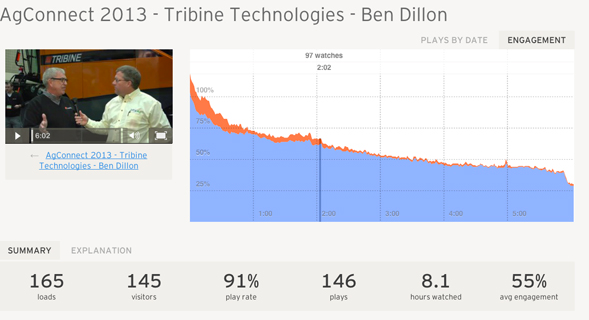
Here’s a great look at the when, where and how today’s executives view and digest online video. Of all the data collected, the one bit of information that surprised me most –  the length of a single video these decision makers are open to watching . While Varvid encourages our partners to keep videos under the 2 minute mark, this research tells us if the content offered is engaging and relevant, a large portion of viewers will watch for up to 5 minutes.  That’s solid information when you are creating an online video that generates results.

If you’d like to know more about how you can tell your story, share a case study, lend some professional expertise or simply get good video online, just ask us.  It’s what we do.

Why Outstanding Mobile Platform Support is Critical

Everyone knows that a chain is only as strong as its weakest link. Well, I like to think of any multi-platform software or service as a chain – if one of the links (platforms) in the chain is weak, well… it’s time to get a new chain. I bring it up because I recently read a blog post by Jeremy over at Never Stop Marketing about an experience he had with the AdobeConnect live conferencing software. Jeremy was testing out the software, trying to connect with a colleague, but the colleague only had mobile devices handy. AdobeConnect didn’t support mobile, so they had to use a different service. That’s why, in Jeremy’s words, it’s important to think “mobile first.”***

In today’s connected world, mobile devices are ubiquitous. One third of American adults own a smartphone, according to a recent Pew study. In the tech industry, that fraction seems much closer to 100%. I see tablets everywhere at conferences, with the iPad dominating usage even in our Microsoft-based ecosystem. However, mobile interfaces and support often continue to lag behind their traditional PC/Mac counterparts. As Jeremy and I agree, this is wrong. Mobile is critical and should be your best-optimized system – because it may be your user’s only option.  For video, we prefer our clients’ viewers to watch our work on the best screen possible.  We’re proud of what we do, and we know that bigger screens make high quality video look better. However, nothing is more critical than the viewer watching the video, regardless of screen size or computing type.

At Varvid, we offer video production, editing, hosting, and webcasting services, and all of those follow our “mobile critical” principle. Our workflow is optimized to deliver files ready to upload (H.264) to mobile oriented delivery platforms, and we make sure that all videos hosted with us are available for playback on mobile devices. When we choose partners for video platforms and webcasting, we pick providers who share our idea that mobile support is paramount. With webcasting, which is decidedly not compatible with mobile by default, we make an extra effort to provide mobile support to the market leading devices. A recent webcast that we worked on was streamed online in four different formats – including state-of-the-art HTML for iOS devices.

How are you supporting your mobile device carrying clients? Does your helpdesk support those users?  How well? AdobeConnect can stand to lose a couple users – can you?

*** For what it’s worth, AdobeConnect is now optimized for mobile, but first impressions are what stick with clients and potential clients.

The Internetageddon Approacheth – In the Meantime, Let’s Make Good Video

The year 2012 is prophesied to be our last. But for those with their ears to the ground, a different sort of apocalypse looms, and a couple of great blog posts over at ReelSEO in the past few days are truly signs of the times. The first, which breaks down Cisco‘s recent Visual Networking Index, tells us that global bandwidth use is increasing at a frightening pace. It’s increasing so quickly, in fact, that many analysts think the rise in online video consumption will eventually break the Internet. Just look at these graphs:

Clearly, we don’t have much time. Fortunately, film writer and director Steve Stockman has stepped forth and written a book of of tips and tricks for making video worth watching in the precious moments we have left – Video that Doesn’t Suck. In his post at ReelSEO, Stockman laid out some great starting tips. Here are a few of his suggestions as they appear in the ReelSEO article:

1) The Audience Comes First.

Think about your video in terms of the experience it’s going to provide for them. If it isn’t going to take them on a fun, emotional ride, maybe your project should be a memo instead. Give the audience a good time and they’ll love you. And vice versa.

2) Keep Your Video Short.

That movie trailer you hated because it showed you the whole movie? Two minutes and thirty seconds long. Your favorite Superbowl TV spot: 30 seconds. Average time spent looking at a web page? 15 seconds. A sales video longer than 3 minutes? Unless it’s for Victoria’s Secret and directed by Martin Scorsese, don’t even think about it. Take the length you intuitively think your video should be, and cut by 2 thirds. That makes your ten minutes sales video about 3 minutes. Which will still be too long if it isn’t great.

3) Bad Sound, Bad Lighting, and Bad Photography Will Kill You.

It’s disrespectful to ask your audience to suffer through dark scenes, hollow, echoey audio, or brain-hurting camera bounces. Worse: they’re instant tune-outs. If it looks bad on camera’s little screen, it won’t get better when you look at it later. Cut it from the finished video.

Here at Varvid, we’ve always held that video – particularly video for businesses – should not suck. That’s why we try to provide all the essential tools our clients need to make great videos – videos that potential clients and business partners will want to watch. With our VENUE packages, we’ll handle the editing, music, graphics, and social media integration. We’ll even train you to abide by Steve’s suck-less rules with our webinars and online video tutorials. To learn more, follow this link or call us at (360) 738-7168.

How Keywords Influence Your Video’s Rank in Universal Search Results

In a recent post on the ReelSEO blog, Jeremy Scott wrote about ways to get your videos seen on the first page of universal (Google, Bing, non-site-specific) search results. Using data from a study performed by Manny Rivas and the aimClear team, Jeremy identified three major factors influencing video rankings:

  • Video upload platform
  • Ranking factors within the platform
  • Keyword Intent

Those first two bullets are easy to understand, and easy to use. Essentially, videos uploaded to YouTube have a better chance of showing up in a Google search than videos uploaded to DailyMotion, MetaCafe, or even Google Video. Even in Bing searches, 38% of videos retrieved are YouTube videos, beating out Bing‘s 37%. For maximum universal search ranking, host your videos on YouTube. That second bullet point means that the better your video ranks in your platform’s internal search engine, the better it will rank in universal searches.

The third bullet point is the really important bit: Keyword Intent. In their study, aimClear identified three categories of keywords: Informational, Navigational, and Transactional. The keywords you use in your video’s description and tags determine which category the search engine places your video in. Informational keywords are phrases like “learn,” “how to,” “history of,” or “what is.” They denote an educational or instructive video. Navigational keywords direct readers to other parts of the web, and they usually appear as a website address, brand name, or brand description. Finally, transactional keywords, as the name implies, are words like “buy,” “cheap,” “sale,” or “free.” According to aimClear’s study, informational keywords rank nearly three times better than navigational and transactional keywords combined.

aimClear's Keyword Intent data

So pay attention to your keywords. Be deliberate in the word choice of your titles and descriptions so that your potential viewers will not only see your video on their results page, but actually feel compelled to click on it. Avoid transactional keywords and the temptation of slick, snake-oil-salesman phrases.

Or you could let us handle it. Not only will we handle the equipment supply and editing for your next web video, we’ll handle the uploading (to YouTube, naturally), tagging, and posting of the video to your social networks. If you want web video to work for you, you want VENUE. Watch the video below for more information.

Aaron Booker on Comcast Business Class Internet Service

Varvid.com founder Aaron Booker talks about Comcast Business Class Internet. Comcast Business Class Internet offers Varvid the fastest way to upload and download videos for their clients. Varvid uses Comcast’s 50/10 connection which gives us 50 Mbps download and 10 Mbps upload speeds – fast enough to make sure our videos are where they need to be, when they need to be. Comcast Business Class Internet is the most cost effective way for small businesses to get high speed internet.

http://www.business.comcast.com/
Comcast Blog


Aaron Booker on File Transfer Platform YouSendIt

Varvid.com founder Aaron Booker expounds the virtues YouSendIt, an online file transfer service. YouSendIt offers fast and secure file transfers for a reasonable price, and is far easier to use than an FTP setup. By pinning the sender’s email address to each file, YouSendIt makes tracking each client’s progress a snap. Aaron uses YouSendIt for his business’s cloud-based video editing service and highly recommends their services for anyone who needs to transfer large files over the web.

Ad-ology Forecast Shows the Number of Small Businesses Investing in Online Video Nearly Doubled From 2010-2011

Ad-ology’s aim is to help media properties, advertising agencies, and businesses get a firm grasp of the industry’s playing field by providing data that these parties can use to analyze their relationships with competitors. According to their website, Ad-ology is “the science of applying consumer insights for strategic advertising and marketing.” The information their reports deliver allows any party to effectively compare themselves to other businesses and companies, and anyone who closely studies the data can tweek their business model to ensure that they’ll stay ahead of the competition.

In a November 2010 study conducted by Ad-ology called the 2011 Small Business Marketing Forecast, it was found that small businesses are looking to new and innovative means of marketing, and the investments being made in these areas are on the rise. According to the study, 45.5 % of small businesses are increasing their spending on Online Video in 2011, which is up from 28% in 2010. This is an enormous increase, and yet another indicator to the trend of online video becoming both more accessible and widely used across the board in the business world.

The president and CEO of Ad-ology Research, C. Lee Smith, says that “small businesses are becoming increasingly savvy on how to market online, and their plans for increased spending on video and mobile show they are ready to try new ways to reach the customer.  They may not have the resources of big businesses, but things like online (video) and social media help level the playing field.” With the new generation of HD video capturing devices, “level the playing field” is a bit of an understatement, which is why the Varvid Staff likes to say that video have become “democratized” as we feel it best defines the significant influence and impact that video is truly having on the business, online marketing, and SEO world. However, whatever words we decide to attach to the internet video phenomena, there is indeed a trend taking place and I know that I’ll be keeping a keen eye out for for future marketing research reports from Ad-ology.

How the Video Viewing of Tomorrow Looks from Today

With the close of the Consumer Electronics Show 2011, and so many exciting and innovative new products revealed, I thought it would be appropriate to look ahead at where these technologies will take the video-viewing world, and whether they’ll have the impact their manufacturers are hoping for.

Let’s start with technology we already have: mobile video. Everyone with a smartphone has the ability now to stream any YouTube video or show on Netflix into the palm of their hand. In fact, the number of mobile views of YouTube videos in 2010 tripled over the previous year’s to a whopping 200 million views per day. With over a billion smartphones in use worldwide, not everyone’s watching – but almost. And many companies who have traditionally only broadcasted their content are now turning to mobile and other app-based interfaces for distribution.

Some – including FCC chairman Julius Genchowski – are even getting worried that the current US wireless infrastructure will not be able to handle the growth in mobile data transmission that is sure to come in the next five years. When Genachowski spoke at CES, he said that he is currently seeking approval from Congress that will allow wireless carriers to buy unused wireless spectrum from TV broadcasting companies at auction, with the government (who licenses the spectrum) and the broadcasting companies each taking a cut of the profits. According to Genachowski, all but 10% of American TV watchers get their TV by digital signal, not by transmission over the wireless spectrum, so a significant portion of it is going un-utilized.

As smartphone adoption grows, so too will their technology continue to approve. What’s next for phones, tablets, and maybe even magazines and newspapers? OLED.

OLED stands for Organic Light-Emitting Diode, which is just what it sounds like – a thin film of organic compounds which produce light when stimulated by an electric current. The big buzz around OLED is that it can be used to make paper-thin, flexible screens, as seen in Samsung’s CES demo above. Not only are the resolution and brightness outstanding, but it also uses a fraction of the power that it takes to run the LCD screens in today’s phones.

In addition to changing the face of smartphones, OLEDs could potentially be used to replace the many millions of tons of paper waste created by the magazine and newspaper industries each year – buy a Wall Street Journal OLED 2-pager (with subscription fee) and it automatically updates itself every morning (while storing a week’s worth of back issues). This platform would also allow to content providers that have traditionally been stuck in the time-consuming text-only medium to branch out and start providing vital information in video form. Sure, many magazines and papers are currently supplying iPad apps that accomplish this, but many iPad news consumers find they miss the convenience of the old form factor. Whether this tech will trend towards tablet consolidation or ePaper diversification remains to be seen.

Finally, most of the consumption of high-value content like shows and movies remains on the only medium which has utterly dominated for over 50 years: the ubiquitous household television.

And of course, the biggest change that’s coming to TV in 2011 is 3D. You’ve seen it on the floor at CES, you’ve seen it at Best Buy, you’ve even seen it in the Target newspaper insert. It seems like the entire TV industry – top-to-bottom – is going whole hog for 3D. But it isn’t without its issues. Many of the current 3D TVs must be viewed with glasses to get the 3D effect. Of the two types of glasses, Active Shutter glasses must be charged, cost over $100 each, and have been said to cause nausea, while the cheap-as-free Passive Shutter glasses take an apparently harsh dip in image crispness, brightness, and 3D “popitude”. Neither technology seems ready for every household, especially when you consider that most Americans would not be too excited about having to wear some fancy glasses just to watch The Office in 3D. That’s why I am personally excited about the forthcoming glasses-free 3D TVs (video above) that we just got a taste of at CES this year. Although plagued with a host of their own technological hurdles, glasses-free 3D seems like it has the best chance of wide adoption, due to ease-of-use and potentially lower cost.

Moving away from pure tech for a moment, I’d like to comment on another aspect of TV viewing that will grow in the next five years – interactivity. Devices like Apple TV and the Google TV-powered Logitech Revue have already added some apps and streaming-content services to our boring old TVs, allowing us to sever the cable connection. But is that enough to call our TVs truly “smart”? Music identification service Shazam is hoping that its new TV tagging platform will take that next step. Currently only available for one show on one channel, Shazam’s TV tagging will allow viewers to active the app (currently on for smartphones) and participate in social activities populated by other current viewers, such as discussions, polls, and even contests.

Broadcast organizations have been bemoaning the great migration of consumers towards online streaming content, which saps the broadcasters advertising revenue. But by linking social media with real-time broadcast (or streaming) content, broadcasters can hope to draw consumers back to the as-it-happens world of scheduled programming (and advertising). Potentially, shows could even have multiple storyline options, with the audience determining which one they want to see broadcast, which would also drive traffic of everyone wanting to see the other option to the broadcaster’s streaming site. I predict we will see a grand evolution in how we watch TV in the next five years – we will be doing much more than watching.

NW Projections Film Festival 2011 Open for Submissions!

NW Projections 2011 Call For Entries from Wilson Large on Vimeo.

The NW Projections Film Festival, born in 2000, is dedicated to showcasing the filmmaking talents of artists from Washington and all over the Pacific Northwest (Oregon, Washington, Idaho, and British Columbia). They are currently accepting shorts and feature films from now until the Early Bird deadline of February 6th, and the Late Registration deadline of March 7th. See the NW Projections website for details.

Check out the winner of last year’s festival, “Dry Rain”.

In addition to getting to see a bunch of great films by local filmmakers, festival goers will also be able to attend workshops from real film industry professional. The list isn’t final yet, but keep checking the NW Projections website to find out more information.

Varvid actually played a role in this years festival, helping festival director Wilson Large set up the first-ever online submission portal for NW Projections. We are proud to help put local filmmaking in the spotlight here in Bellingham. At Varvid, we recognize the importance of visual media, as it allows human beings to express themselves in ways that were entirely impossible prior to the establishment of the cinematic art form.

More Executives Turning to Video for Business Developments, News and Potential Clients

According to Forbes Insight’s December 2010 report “Video in the C-Suite” more business leaders are altering their habits and becoming more open to video as a means of communication and embracing the non-text web. The study was conducted on more than 300 C-level and senior executives at large U.S. companies valued at $500 million-plus in annual revenues, in order to gain a perspective on how some of the industries major players utilize web-video as a source of news, information and marketing.

The Forbes study reveals that a little over 80% of executives said they are watching more online video today than they were a year ago, 75% watch work related video on business related websites at least weekly, more than half (52%) watch work-related videos no less than once a week on YouTube, and a whopping 65% have visited a vendor’s site after watching one of their videos. The data also suggests that web-video is indeed a business trend and not an ephemeral phase, as younger executives tended to be more fully engaged with online video media and were more viable candidates to make a purchase, call a vendor, or respond to an ad than their elder counterparts.

Aaron Booker

“There’s a significant paradigm shift taking place right before our eyes.”
I showed these results to Varvid CEO Aaron Booker and he wasn’t in the least bit surprised. He told me “I remember back in the early days of the IT industry when we’d all say ‘if it’s not online, it doesn’t exist’. Well, now there’s a significant paradigm shift taking place right before our eyes. We live in a world where everything and anyone can be found online in pictures in text, and it’s video content that is lacking. Now, the standard has become ‘if it’s not on internet video, it doesn’t exist’ which is why I see so much value in what Varvid offers our clients”.

To view the report yourself, check out: http://www.forbes.com/forbesinsights/video_in_the_csuite/index.html and the pdf can be found here: http://images.forbes.com/forbesinsights/StudyPDFs/Video_in_the_CSuite.pdf .

Page 1 of 3123»